Here is the sensory path, a collection of plants that emphasises the fragrant essences, the leathery or tomentose leaves, the wrinkled barks.
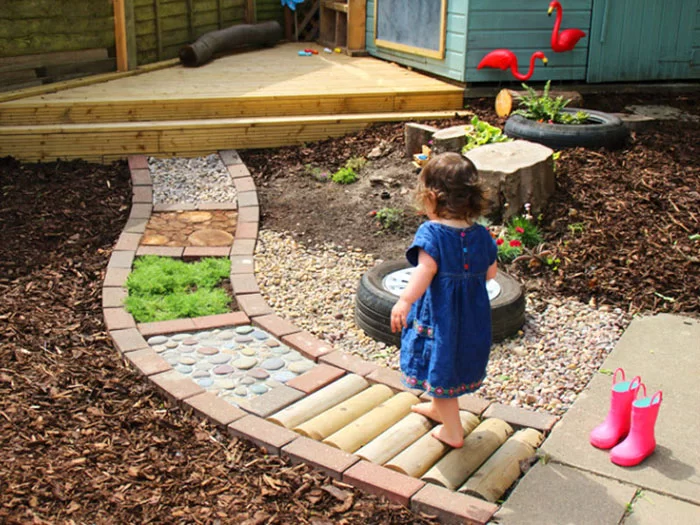
You can also take your shoes off to appreciate the difference in the route’s coatings; earth, gravel, grass, lava stone wood, and at the end of the route, you can wash your feet at a fountain.
The beginning of the route is marked by a small forest of coloured sticks, positioned among some typical Mediterranean shrubs, including the fragrant myrtle and cistus (rusedda), a typical plant of the Caltagirone forests, which flowers in spring.
Immediately afterwards, you will pass through the rustling grasses – pennisetum, briza, stipa – which mark the gates of the sensory garden.
This is followed, in succession, by patches of shrubs in various colours, first white, then yellow, and red. Enjoy the walk leisurely, taking the opportunity to touch the leaves and barks, and appreciate the different textures. Next to each plant, a label will tell you its name and special features.
Take a break under the pergola among the medicinal and condiment plants arranged on the right.
More than 70 per cent of the medicines available in pharmacies are produced more or less directly from active plant extracts. The discovery of new active ingredients continues to help fight old and new diseases. Small changes in the form and/or dosage of some species can, however, turn a medicinal plant into a toxic one.
There are plants that act on the circulatory system, like garlic, others that affect the urinary system, such as horsetail or dandelion, and some that target the respiratory system, like eucalyptus.
The use of plants for medicinal purposes is called phytotherapy. Plants can be used in different forms: infusions, decoctions, compresses, macerates… Depending on the part of the plant used, the effects will be different.
This website or its third-party tools process personal data.In case of sale of your personal information, you may opt out by using the link Non vendere le mie informazioni personali.
This website uses cookies to improve your experience while you navigate through the website. Out of these, the cookies that are categorized as necessary are stored on your browser as they are essential for the working of basic functionalities of the website. We also use third-party cookies that help us analyze and understand how you use this website. These cookies will be stored in your browser only with your consent. You also have the option to opt-out of these cookies. But opting out of some of these cookies may affect your browsing experience.
Necessary cookies are absolutely essential for the website to function properly. These cookies ensure basic functionalities and security features of the website, anonymously.
Cookie
Durata
Descrizione
cookielawinfo-checkbox-analytics
11 months
This cookie is set by GDPR Cookie Consent plugin. The cookie is used to store the user consent for the cookies in the category "Analytics".
cookielawinfo-checkbox-functional
11 months
The cookie is set by GDPR cookie consent to record the user consent for the cookies in the category "Functional".
cookielawinfo-checkbox-necessary
11 months
This cookie is set by GDPR Cookie Consent plugin. The cookies is used to store the user consent for the cookies in the category "Necessary".
cookielawinfo-checkbox-others
11 months
This cookie is set by GDPR Cookie Consent plugin. The cookie is used to store the user consent for the cookies in the category "Other.
cookielawinfo-checkbox-performance
11 months
This cookie is set by GDPR Cookie Consent plugin. The cookie is used to store the user consent for the cookies in the category "Performance".
viewed_cookie_policy
11 months
The cookie is set by the GDPR Cookie Consent plugin and is used to store whether or not user has consented to the use of cookies. It does not store any personal data.
Functional cookies help to perform certain functionalities like sharing the content of the website on social media platforms, collect feedbacks, and other third-party features.
Performance cookies are used to understand and analyze the key performance indexes of the website which helps in delivering a better user experience for the visitors.
Analytical cookies are used to understand how visitors interact with the website. These cookies help provide information on metrics the number of visitors, bounce rate, traffic source, etc.
Advertisement cookies are used to provide visitors with relevant ads and marketing campaigns. These cookies track visitors across websites and collect information to provide customized ads.

Commenti recenti