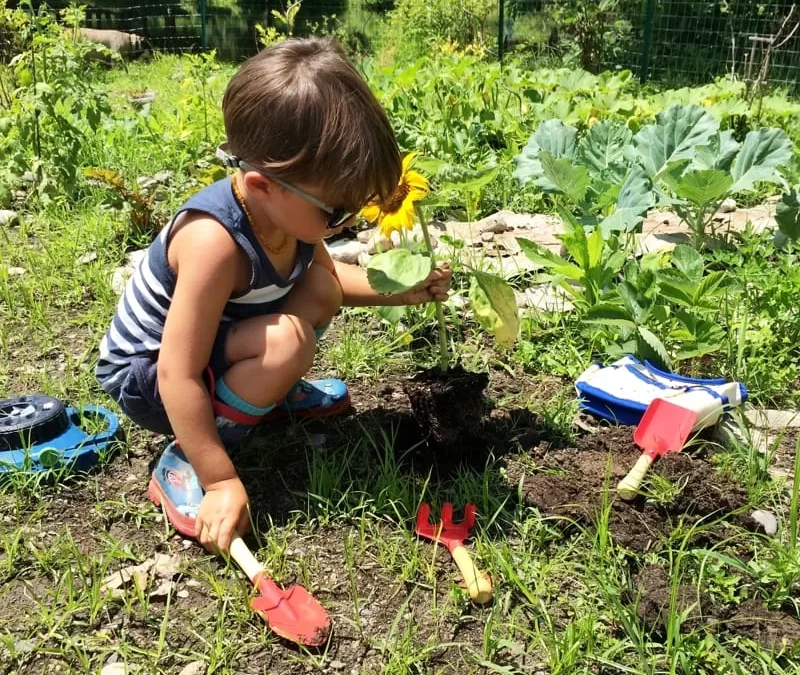
Here, you’re at the outdoor workshop. It’s used for events, especially children’s workshops.
Signs show the best way to compost, reduce water consumption, or protect a garden while respecting the environment… These examples are put into practice in the garden around you. For example, find the compost and you will see 3 containers: one for the branch shavings, one for the new compost, and the third for the mature compost that will enrich the garden soil.
Edible plants
You now reach the first collection presenting edible plants. Humans have been cultivating plants for 10,000 years. In the flowerbeds of this collection you’ll find local and exotic edible plants. At the level of the flowerbeds on the side, you’ll find a presentation of seasoning and aromatic plants.
As for local species, you’ll find fennel with its small yellow flowers. …There are also some edible flowers such as nasturtiums, borage flowers or fuchsia…
As for seasoning plants, you will find exotic ones such as the curry plant, ginger or stevia, and more rustic ones such as sage, thyme or rosemary.
Other wild plants can be eaten but care must be taken when picking them. Some may look edible but are poisonous. It’s therefore preferable to be informed before picking them.
On the upper level terrace is a collection of ancient fruits.
Ancient fruits must be considered cultural elements, “creations” of the farmers who selected them for their adaptability, rusticity, disease resistance, cared for and domesticated through locally shared cultivation practices. The fruits of the past are basic elements of traditional agriculture and agrobiodiversity, characterised by unparalleled flavours, fragrances and knowledge. They constitute a genetic, economic, social and cultural heritage of extraordinary value, made up of peasant and artisan inheritances that aren’t always written down, but are rich and complex. The collection of ancient fruits makes it possible to maintain the area’s historical memory, encourages the recovery of knowledge about the names, uses and agronomic aspects of the products.
This website or its third-party tools process personal data.In case of sale of your personal information, you may opt out by using the link Non vendere le mie informazioni personali.
This website uses cookies to improve your experience while you navigate through the website. Out of these, the cookies that are categorized as necessary are stored on your browser as they are essential for the working of basic functionalities of the website. We also use third-party cookies that help us analyze and understand how you use this website. These cookies will be stored in your browser only with your consent. You also have the option to opt-out of these cookies. But opting out of some of these cookies may affect your browsing experience.
Necessary cookies are absolutely essential for the website to function properly. These cookies ensure basic functionalities and security features of the website, anonymously.
Cookie
Durata
Descrizione
cookielawinfo-checkbox-analytics
11 months
This cookie is set by GDPR Cookie Consent plugin. The cookie is used to store the user consent for the cookies in the category "Analytics".
cookielawinfo-checkbox-functional
11 months
The cookie is set by GDPR cookie consent to record the user consent for the cookies in the category "Functional".
cookielawinfo-checkbox-necessary
11 months
This cookie is set by GDPR Cookie Consent plugin. The cookies is used to store the user consent for the cookies in the category "Necessary".
cookielawinfo-checkbox-others
11 months
This cookie is set by GDPR Cookie Consent plugin. The cookie is used to store the user consent for the cookies in the category "Other.
cookielawinfo-checkbox-performance
11 months
This cookie is set by GDPR Cookie Consent plugin. The cookie is used to store the user consent for the cookies in the category "Performance".
viewed_cookie_policy
11 months
The cookie is set by the GDPR Cookie Consent plugin and is used to store whether or not user has consented to the use of cookies. It does not store any personal data.
Functional cookies help to perform certain functionalities like sharing the content of the website on social media platforms, collect feedbacks, and other third-party features.
Performance cookies are used to understand and analyze the key performance indexes of the website which helps in delivering a better user experience for the visitors.
Analytical cookies are used to understand how visitors interact with the website. These cookies help provide information on metrics the number of visitors, bounce rate, traffic source, etc.
Advertisement cookies are used to provide visitors with relevant ads and marketing campaigns. These cookies track visitors across websites and collect information to provide customized ads.

Commenti recenti